
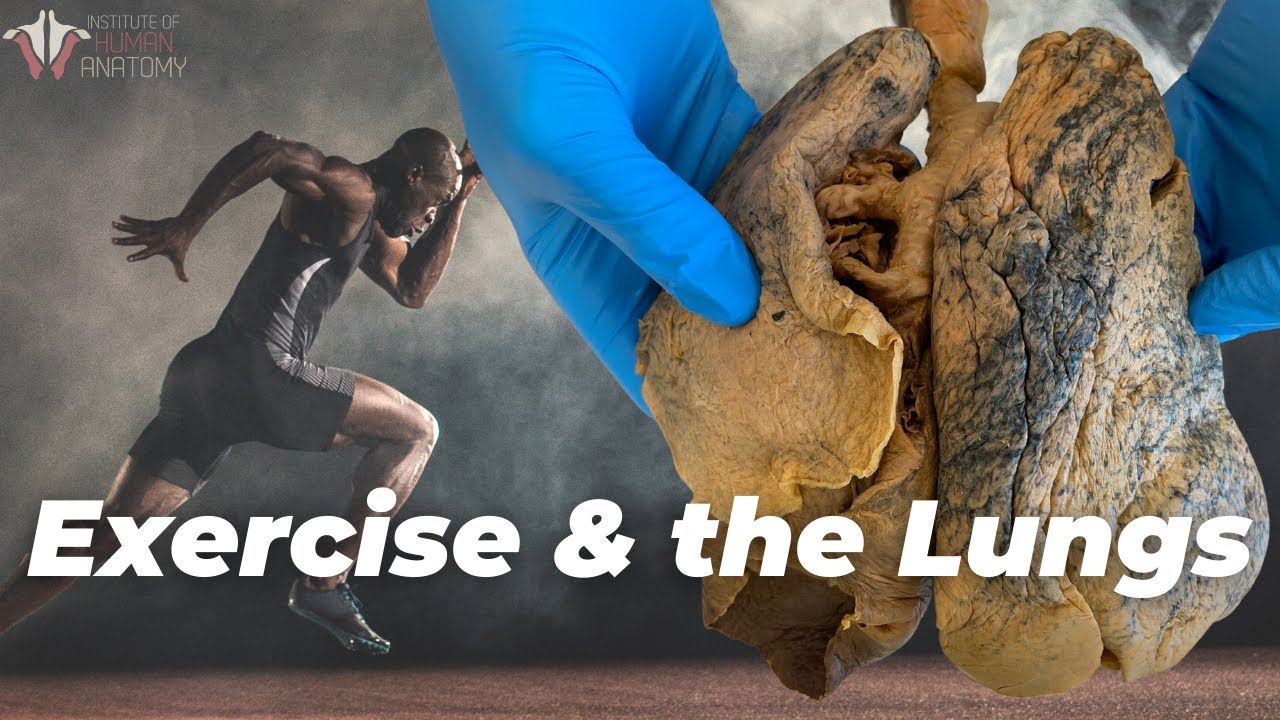
🔥 How Your Lungs Change With Exercise
📌 Comprehensive Summary
- 🌬️ The Critical Role of Breathing – [00:31]
Principle: Breathing is essential for life, and exercise increases the demand for oxygen.
Inference: The lungs must work harder to ensure a continuous supply of oxygen while removing carbon dioxide. - 🫁 How Breathing Works – The Basics – [01:01]
Principle: The diaphragm contracts, pulling downward to create negative pressure and draw air into the lungs.
Inference: This mechanism allows oxygen to enter and supports the body’s metabolic needs. - 💨 The Journey of Air Through the Respiratory Tract – [01:33]
Principle: Air moves through the nasal or oral cavity, down the trachea, and branches into smaller bronchioles before reaching alveoli.
Inference: The complex branching structure maximizes surface area for gas exchange. - 🔄 Oxygen and Carbon Dioxide Exchange at the Alveoli – [02:04]
Principle: Oxygen enters the bloodstream while carbon dioxide exits through diffusion at the alveoli.
Inference: Efficient gas exchange is crucial for maintaining performance during exercise. - 🏃♂️ The Dramatic Increase in Breathing During Exercise – [02:35]
Principle: Pulmonary ventilation can increase by up to 20 times during intense exercise.
Inference: The body adapts to oxygen demands by increasing both breathing rate and tidal volume. - 📊 How Much Oxygen Do We Actually Use? – [03:05]
Principle: Resting oxygen consumption is ~250ml/min, increasing to 5,100ml/min for elite athletes.
Inference: Oxygen demand grows significantly with training and athletic performance. - 🔍 The Myth of Increasing Lung Capacity – [06:13]
Principle: The thoracic cavity size limits lung expansion, meaning lung capacity remains relatively unchanged.
Inference: Other physiological adaptations, rather than lung size, determine aerobic performance. - 💓 The Heart – The Real Limiting Factor – [08:47]
Principle: The heart determines how much oxygen is transported to muscles.
Inference: Cardiovascular adaptations, not lung changes, are the key to improved endurance. - 📈 The Reserve Capacity of the Lungs – [07:45]
Principle: The lungs’ maximal breathing capacity is about 50% higher than what is needed in maximal exercise.
Inference: The respiratory system is overbuilt to handle extreme conditions like high altitude or heat. - 🔬 Oxygen Diffusing Capacity as a True Lung Adaptation – [11:23]
Principle: Exercise increases capillary density around alveoli, improving oxygen diffusion.
Inference: While lungs don’t grow, their efficiency improves slightly in trained individuals. - 💪 Strengthening the Breathing Muscles – [11:53]
Principle: The diaphragm and intercostal muscles grow stronger with regular exercise.
Inference: Enhanced breathing efficiency supports endurance and physical performance. - 🚀 Who Actually Pushes Their Lung Limits? – [10:20]
Principle: Only elite endurance athletes may experience lung limitations.
Inference: Most people see greater benefits from cardiovascular and muscular improvements.
📊 Insights Based on Numbers
- 250ml/min → 5100ml/min: The vast increase in oxygen consumption from rest to elite performance.
- 100-110L/min vs 150-170L/min: Shows that lung reserve is far greater than what’s typically needed in exercise.
- 20x Increase in Ventilation: Highlights the remarkable adaptability of the respiratory system.
❓ Example Exploratory Questions
- Why is lung capacity not the main limiting factor in endurance performance? (*Enter **E1** to ask*)
- How does strengthening breathing muscles improve exercise efficiency? (*Enter **E2** to ask*)
- What cardiovascular adaptations help maximize lung oxygen supply? (*Enter **E3** to ask*)