
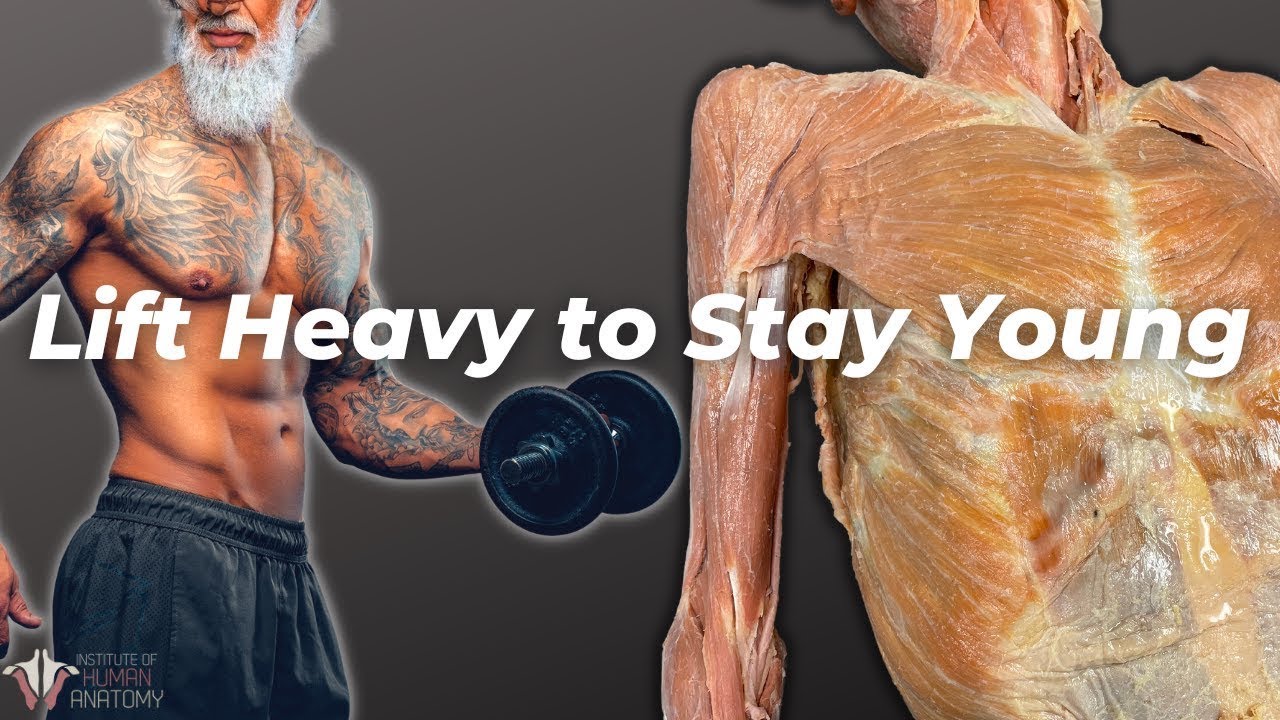
🏋️ How to Save Your Muscles From Aging
1. 🔥 The Importance of Heavy Resistance Training
Point: Many believe heavy weightlifting is only for athletes, but everyone should incorporate it into their routine.
Principle: Strength training is the most effective way to combat muscle loss as we age.
Inference: Without proper resistance training, aging leads to a significant reduction in muscle mass and function.
2. 🏗️ Muscle Loss Starts in Your 30s
Point: From our 30s, we lose 3-5% of our muscle mass per decade, increasing to 10% per decade after 50.
Principle: Muscle atrophy accelerates with age, leading to reduced mobility and strength.
Inference: Without intervention, aging naturally leads to frailty and loss of independence.
3. 🔬 The Science of Muscle Fibers
Point: Muscles are made up of thousands of muscle fibers, categorized into fast-twitch and slow-twitch.
Principle: Fast-twitch fibers produce more power but fatigue quickly, while slow-twitch fibers are better for endurance.
Inference: Aging results in a disproportionate loss of fast-twitch fibers, reducing strength and explosiveness.
4. 🏋️♂️ Fast-Twitch vs. Slow-Twitch Fiber Loss
Point: Aging disproportionately affects fast-twitch muscle fibers, leading to decreased power output.
Principle: The body’s natural muscle recruitment pattern prioritizes slow-twitch fibers first.
Inference: Without heavy resistance training, fast-twitch fibers remain unused and deteriorate over time.
5. ⚙️ The Role of the Nervous System in Muscle Loss
Point: The nervous system recruits muscle fibers in a sequence, prioritizing slow-twitch before fast-twitch.
Principle: Heavy lifting is required to engage fast-twitch fibers, as light activities only use slow-twitch fibers.
Inference: Activities like walking, yoga, and light resistance training are not enough to prevent fast-twitch fiber loss.
6. 💪 Effective Training for Fast-Twitch Fiber Activation
Point: Heavy lifting (4-8 reps) and explosive movements like sprints and jumps effectively recruit fast-twitch fibers.
Principle: The heavier the weight or the faster the movement, the more fast-twitch fibers are engaged.
Inference: Incorporating both heavy resistance training and explosive exercises optimizes muscle preservation.
7. 📊 How Much Strength Training is Needed?
Point: As little as 10-15 working sets per muscle group per week is enough to maintain strength.
Principle: The load should be heavy enough that only 4-8 reps are possible.
Inference: Even busy individuals can fit effective strength training into their routines.
8. 🏃 The Role of Explosive Training
Point: Explosive exercises like box jumps and medicine ball throws activate fast-twitch fibers.
Principle: Speed-based movements provide an alternative to heavy lifting.
Inference: A mix of heavy lifting and explosive training provides the best results for muscle retention.
9. ⚠️ Concern: Will Strength Training Make Muscles Too Big?
Point: Strength training does not necessarily lead to large muscles unless specifically programmed for hypertrophy.
Principle: High-volume training is required for significant muscle growth, not just heavy lifting.
Inference: Those who want strength without bulk can still benefit from resistance training.
10. 🚶♂️ Foot Speed & Fall Prevention
Point: Losing fast-twitch fibers reduces foot speed, increasing the risk of falls as we age.
Principle: Exercises that enhance foot speed (like hop drills) can help prevent falls.
Inference: Strength training helps maintain mobility and independence in older adults.
11. 🏆 The Best Training Approach for Muscle Longevity
Point: A mix of heavy lifting, explosive training, and proper recovery maximizes muscle retention.
Principle: Engaging fast-twitch fibers is crucial for maintaining muscle mass with age.
Inference: Proper training can slow or even reverse age-related muscle loss.
💡 Final Thoughts & Knowledge Gaps
- 📌 Heavy resistance training is essential to prevent age-related muscle loss.
- 📌 Fast-twitch fibers deteriorate first, making strength training crucial.
- 📌 Strength training does not automatically lead to large muscles.
- 📌 Preserving muscle mass helps prevent falls and maintain independence.
- 📌 A mix of resistance and explosive training is the best approach.


