
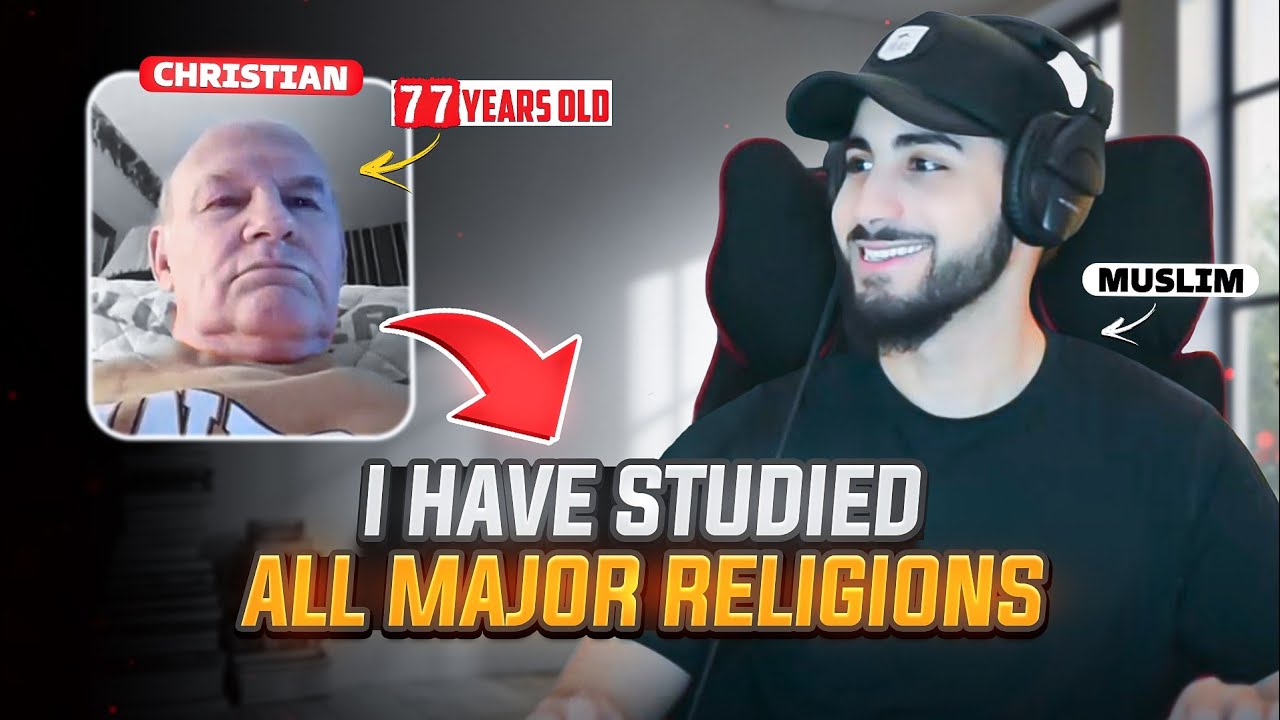
🔥 Christian vs. Muslim Debate: Can a Veteran Convert a Muslim?
A Clash of Beliefs on Jesus, Salvation & Scripture
🔗 Watch Full Video: 77-Year-Old Christian Veteran vs. Muslim Scholar
🧠 Who Are the Speakers?
1️⃣ Christian Veteran (Roy) – The Missionary Perspective
🔹 Background: 77-year-old Christian, a veteran who has studied various religions for 40+ years.
🔹 Stance: Believes that Jesus is the only way to God, that the Bible is historically reliable, and that Islam contradicts proven Christian doctrine.
2️⃣ Muslim Speaker (Muhammad Lantern) – The Apologist’s Response
🔹 Background: Muslim apologist and debater, well-versed in Islamic theology and comparative religion.
🔹 Stance: Argues that Jesus was not divine, the Bible is historically unreliable, and Islam is the continuation of God’s message.
🏆 1️⃣ The John 14:6 Debate – “I Am the Way, the Truth, and the Life”
🔹 Roy’s Argument:
Jesus says, “I am the way, the truth, and the life. No one comes to the Father except through me.”
› This means Jesus is the exclusive path to salvation.
› The “Father” refers to God in heaven, so Jesus is the only way to eternal life.
› Rejecting Jesus = No heaven.
🔹 Muhammad Lantern’s Response:
› If Jesus is “the way” to God, then he is not God.
› Being “the way” implies a separate entity leading to something greater.
› Every prophet was the way to God for their people.
› Therefore, this verse does not prove Jesus is God but rather the opposite.
🔹 Objective Rebuttal:
› Jesus saying “the way” doesn’t negate divinity—a king can be “the way” to his own kingdom.
› The phrase “no one comes to the Father except through me” suggests exclusivity, unlike other prophets.
🛑 Prejudicial Device Used:
• Equivocation (Wordplay Bias): The meaning of “way” is debated to support different conclusions.
• Cherry-Picking: Each side ignores other verses that might challenge their stance.
🔎 Philosophical Assumption:
• Roy: Truth is exclusive—only one path to God.
• Muhammad Lantern: Truth is progressive—different prophets were “the way” in their time.
📜 2️⃣ Biblical Authority – Is the Bible Historically Reliable?
⏳ Biblical Manuscripts vs. Quran
🔹 Roy’s Argument:
› The New Testament has physical manuscripts dating to 100-200 AD, proving it is reliable.
› The Quran came 600 years later, meaning it contradicts earlier records.
› If the Bible is historically verified, then Islam’s rejection of it is false.
🔹 Muhammad Lantern’s Response:
› The earliest full Bible manuscripts (Codex Sinaiticus, Vaticanus) are from the 4th century—300+ years after Jesus.
› The Quran doesn’t contradict history—it corrects distortions in the Bible.
› Age of a text doesn’t determine truth (Hinduism is older than Christianity).
🔹 Objective Rebuttal:
› While early manuscripts exist, they contain variants, meaning changes happened over time.
› The Quran’s late arrival doesn’t disprove Christianity, but it does create a historical gap in claims.
🛑 Prejudicial Device Used:
• Appeal to Antiquity: Assuming that older = more accurate.
• False Equivalence: Claiming all late texts must be false, ignoring progressive revelation.
🔎 Philosophical Assumption:
• Roy: Continuity = Truth—the Bible has historical documentation, making it true.
• Muhammad Lantern: Correction = Truth—God sends revelations to correct past mistakes.
✝️ 3️⃣ The Crucifixion: The Core of Christianity
🔹 Roy’s Argument:
› The New Testament, Roman & Greek historians confirm Jesus’ crucifixion.
› Even Bart Ehrman (agnostic historian) says Jesus’ death is one of the most well-documented facts in history.
› The Quran denies this, contradicting overwhelming historical evidence.
🔹 Muhammad Lantern’s Response:
› The Quran doesn’t deny people believed Jesus was crucified—it says it appeared so to them.
› Historians record events based on human perception, not divine knowledge.
› Lack of eyewitness writings from Jesus’ followers weakens the historical certainty.
🔹 Objective Rebuttal:
› If multiple historical sources confirm the crucifixion, then denying it requires strong counterproof.
› “Appeared to be” crucified is vague—does it mean illusion, substitute, or misunderstanding?
🛑 Prejudicial Device Used:
• Appeal to Authority (Roy): Citing historians doesn’t prove divine truth, only human records.
• Ambiguity (Muhammad Lantern): Saying “appeared so” leaves room for multiple interpretations.
🔎 Philosophical Assumption:
• Roy: If Jesus died and rose, Christianity is true.
• Muhammad Lantern: If God says Jesus wasn’t crucified, historical records are flawed.
📖 4️⃣ Paul’s Influence – Is Christianity Built on His Writings?
🔹 Roy’s Argument:
› Paul’s letters form much of Christian doctrine (salvation by faith, Jesus as divine).
› If Paul is a fraud, Christianity collapses.
› New Testament manuscripts confirm Paul’s influence.
🔹 Muhammad Lantern’s Response:
› Paul contradicted Jesus’ teachings (law vs. grace, works vs. faith).
› James & Peter disagreed with Paul on doctrine.
› Paul’s conversion story changed in Acts—raising doubts about his credibility.
🔹 Objective Rebuttal:
› Paul’s teachings expanded on Jesus’ words, but they weren’t direct contradictions.
› If Paul was unreliable, why did early Christians preserve his letters?
🛑 Prejudicial Device Used:
• Straw Man (Muhammad Lantern): Overemphasizing Paul’s contradictions without full context.
• Appeal to Tradition (Roy): Assuming that since Paul’s writings survived, they must be true.
🔎 Philosophical Assumption:
• Roy: Christianity = Jesus + Paul’s teachings.
• Muhammad Lantern: True Christianity = only Jesus’ words, Paul changed it.
📖 📌 Key Takeaways: What’s the Truth?
✅ John 14:6 doesn’t necessarily prove divinity—depends on interpretation.
✅ The Bible has early manuscripts, but textual changes exist.
✅ The crucifixion is well-documented, but the Quran challenges human perception of it.
✅ Paul’s influence on Christianity is undeniable—but was he divinely inspired?
🔗 Watch Full Debate: 77-Year-Old Christian Veteran vs. Muslim Scholar 🔥


