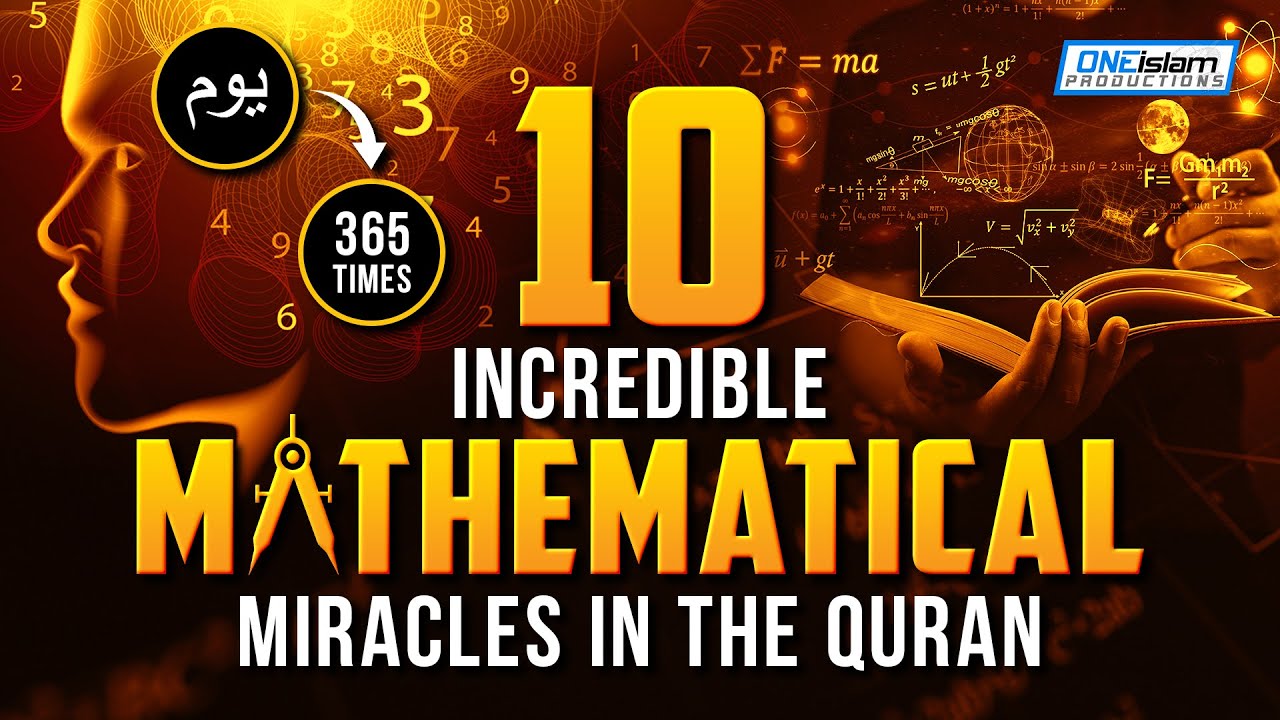
10 INCREDIBLE MATHEMATICAL MIRACLES IN THE QURAN
TL;DR – Save Time, Gain Enlightenment ⏳💡
Reading this post will save you approximately 15 minutes of video time, providing you with an in-depth understanding of the mathematical miracles in the Quran. You will walk away with fascinating insights into divine numerical patterns and their significance.
Introduction: Divine Mathematics in the Quran 📖✨
The Quran is often considered a divine book of guidance, but did you know it also contains mathematical patterns that seem too precise to be coincidental? These patterns, which have been extensively analyzed, reveal astonishing symmetry, numerical codes, and mathematical sequences embedded within its verses. Could these be signs of divine authorship? Let’s delve deep into 10 mind-blowing mathematical miracles in the Quran that will challenge your perception of sacred texts.
1. The Mystery of Number 19 🔢🕌
📌 Pain Point: Skepticism about divine authorship of religious texts.
👤 Target Audience: Believers, scholars, and those interested in Quranic studies.
🤔 Why It Matters: The number 19 appears too frequently to be random, making it a central numerical pattern in the Quran.
📌 Evidence & Steps:
- The word Allah appears 2,698 times in the Quran. Multiply the number of surahs (114) by the number of verses describing Allah, and you get 2,698, a multiple of 19.
- The Bismillah (In the Name of Allah) phrase appears 114 times (19 × 6) in the Quran.
- The first verse of the Quran contains 19 letters.
🔗 Watch this explanation (00:01:37)
2. The Golden Ratio (1.618) & The Quran 📏✨
📌 Pain Point: The belief that the Quran is purely spiritual with no scientific connections.
👤 Target Audience: Science enthusiasts, mathematicians, and students of sacred geometry.
🤔 Why It Matters: The golden ratio is found in nature, art, and now in the Quran, revealing a mathematical harmony.
📌 Evidence & Steps:
- The total number of verses (6,236) divided by the number of surahs (114) = 54.6.
- Multiplying this value by the number of verses in the first Surah gives 382, which is equal to the total verses in the first and last 17 surahs combined.
🔗 Watch the mathematical explanation (00:03:45)
3. The Symmetry of Surah Al-Mulk ⚖️🕋
📌 Pain Point: Belief that Quranic composition lacks structure.
👤 Target Audience: Linguists, literary scholars, and analytical thinkers.
🤔 Why It Matters: The perfect balance in word count proves a deliberate design.
📌 Evidence & Steps:
- Surah Al-Mulk (Chapter 67) has 30 verses.
- The first half (verses 1-15) contains exactly 140 words.
- The second half (verses 16-30) contains exactly 140 words.
🔗 See the breakdown (00:05:18)
4. The Numeric Value of Bismillah (786) 🔣✨
📌 Pain Point: Misconception that numbers in the Quran hold no hidden meaning.
👤 Target Audience: Numerology enthusiasts, Islamic scholars, and mathematicians.
🤔 Why It Matters: The numeric value of Bismillah perfectly aligns with Quranic mathematical patterns.
📌 Evidence & Steps:
- The Arabic letters in Bismillah have a cumulative numeric value of 786.
- If we multiply the values of each letter, the product remains 786.
🔗 Watch how this is calculated (00:06:22)
5. The Significance of Number 7 in the Quran 🌌🌀
📌 Pain Point: Overlooking the repetition of key numbers in scripture.
👤 Target Audience: Those interested in theology, philosophy, and sacred numbers.
🤔 Why It Matters: The number 7 appears across multiple domains—creation, warnings, and sacred rituals.
📌 Evidence & Steps:
- 7 heavens, 7 earths, and 7 major sins mentioned in the Quran.
- The word Sabah (Seven) appears exactly 147 times, a multiple of 7.
🔗 Explore this concept (00:10:35)
6. The Hidden Numerical Patterns of Surah Al-Qamar 🌙🌓
📌 Pain Point: Ignoring hidden structures in Quranic chapters.
👤 Target Audience: Linguists, Quranic researchers, and skeptics.
🤔 Why It Matters: Surah Al-Qamar’s structure mirrors the moon cycle numerically.
📌 Evidence & Steps:
- The word ‘moon’ appears 27 times, reflecting the moon’s cycle of 29.5 days.
- The total verses (55) plus Surah number (54) = 109. Subtracting from total Surahs (114) leaves 5, linking to lunar cycles.
🔗 Watch this breakdown (00:07:27)
Conclusion 🏆📜
The Quran is not just a religious text; it carries within it a mathematical structure that defies randomness. Whether you are a believer or a skeptic, these numerical patterns challenge conventional thinking and open new perspectives on the divine origin of the Quran.
✅ What’s Next? Take Action!
📥 Download the One Islam TV App – for more content on the miracles of the Quran!
📚 Research Further – Dive into studies on Quranic numerology to explore more.
📣 Share this with others – Challenge and inspire them with these revelations.