
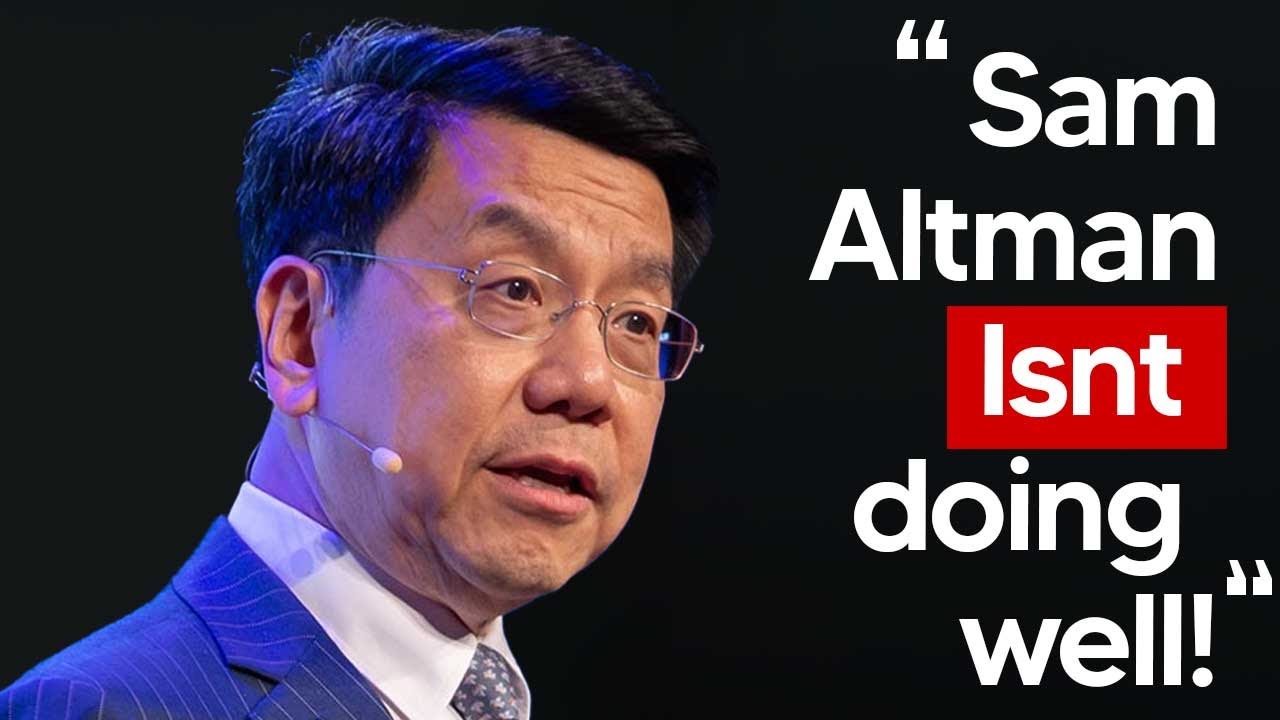
China’s AI Titan Challenges Sam Altman: Why OpenAI’s Business Model May Be Falling Apart
1a. 00:00 – Kai-Fu Lee Says OpenAI’s Costs Are Unsustainable
• Kai-Fu Lee (renowned Chinese AI expert and investor, often called “The Oracle of AI”) claims OpenAI’s $7 billion operational cost in 2024 is a major weakness.
• Inference: OpenAI’s closed-source, high-cost model may not survive against cheaper, open-source alternatives.
• Leads to: Questions about OpenAI’s financial future.
• Consequences:
• Investors lose confidence.
• Pressure to pivot business strategy.
• Opportunities for rivals to rise.
2a. 00:30 – DeepSeek Operates at a Fraction of the Cost
• DeepSeek, a Chinese open-source AI lab, reportedly operates with just 2% of OpenAI’s expenses.
• Inference: Low-cost open-source models can match or outperform expensive closed models.
• Leads to: Open-source AI emerges as a market equalizer.
• Consequences:
• Tech democratization.
• Threat to premium AI subscriptions.
• Shift in public trust.
3a. 01:56 – Is OpenAI’s Model Even Viable?
• OpenAI may lose billions per year competing with free or cheap open models.
• Inference: Financial scalability of OpenAI’s approach is deeply flawed.
• Leads to: Urgency for business model transformation.
• Consequences:
• Shift from research to product monetization.
• Cost-cutting or restructuring.
• Dependency on Microsoft or other investors grows.
4a. 02:19 – OpenAI Calls for Banning Chinese AI
• OpenAI labels DeepSeek a “state-controlled” model and suggests banning PRC (People’s Republic of China)-linked AI in the U.S.
• Inference: Strategic geopolitical move to remove competition.
• Leads to: Global AI cold war.
• Consequences:
• Regulatory scrutiny.
• Rising tensions in tech diplomacy.
• Fragmentation of the global AI market.
5a. 03:42 – DeepSeek Surpasses Major AI Benchmarks
• DeepSeek V3 reaches top of non-reasoning AI benchmarks, briefly surpassing OpenAI’s models.
• Inference: Technical advantage is shifting toward cheaper models.
• Leads to: Competitive panic in the U.S. AI sector.
• Consequences:
• AI talent migration to open platforms.
• Benchmark manipulation allegations.
• Increased focus on model optimization.
6a. 04:36 – DeepSeek Used by Developers Despite Simplicity
• Although DeepSeek feels “generic” to some, many developers use it daily due to low cost and strong performance.
• Inference: Practical utility beats fancy branding.
• Leads to: Developer communities shift to functional over flashy.
• Consequences:
• OpenAI’s brand loyalty erodes.
• Open models gain community traction.
• Shift in educational tools and platforms.
7a. 05:00 – DeepSeek R2 Could Leap Beyond Existing Models
• R2 (next version) could outperform current reasoning models like GPT-4.5 and Claude.
• Inference: DeepSeek’s rapid iteration pace threatens established players.
• Leads to: OpenAI must innovate faster or fall behind.
• Consequences:
• Resource reallocation at OpenAI.
• Faster model development cycles.
• Global race for AI dominance accelerates.
8a. 05:32 – AI Industry Is Consolidating Around Equal Model Quality
• Most models are converging in capability, making user experience the new battlefield.
• Inference: Innovation shifts from raw AI power to usability and access.
• Leads to: Focus on platform design, not just model performance.
• Consequences:
• UX (user experience) becomes central to AI success.
• UI-driven (user interface) companies gain edge.
• Personalized AI agents emerge as differentiators.
9a. 05:95 – Sam Altman Prioritizes User Base Over AI Dominance
• Altman says a billion daily users is more valuable than having the best model.
• Inference: OpenAI shifts from research focus to platform growth.
• Leads to: New strategy centered on consumer apps.
• Consequences:
• Rise of ChatGPT as a consumer product.
• Enterprise sales take a backseat.
• Focus on sticky user engagement.
10a. 06:26 – OpenAI’s Future: Tech Company, Not Just Research Lab
• OpenAI is now a profit-driven tech company with a user growth mandate.
• Inference: Mission drift from non-profit research roots.
• Leads to: Ethical and strategic debates.
• Consequences:
• Risk of investor-driven AI decisions.
• User-centric design eclipses safety measures.
• Trust trade-offs between speed and security.