
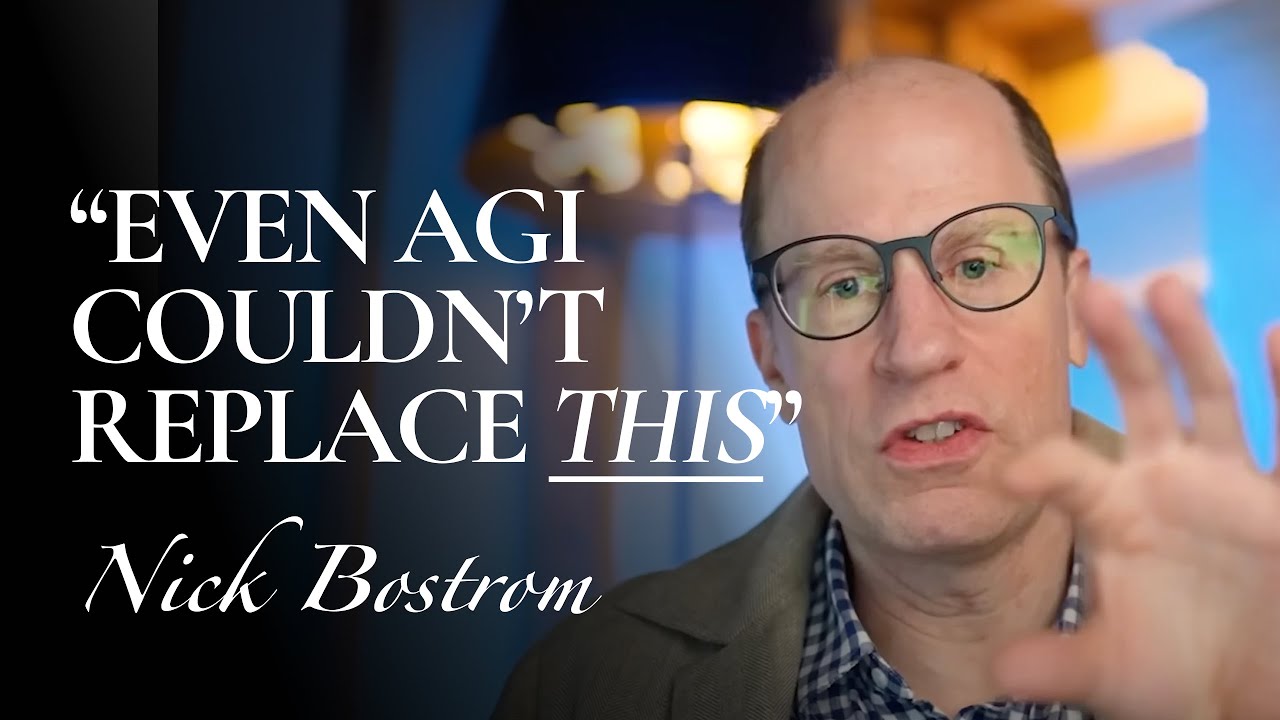
Nick Bostrom on the Future of Human Purpose: Navigating AGI-Proof Meaning in a Post-Work World
• 00:00 – AI Shifts Human Payoffs: Prioritize Learning, Relationships & Capital
• Nick Bostrom (philosopher and AI theorist known for work on existential risk) outlines 3 areas resistant to AI: learning over production, relationships over things, and capital over labor.
• Inference: Humans should focus on irreplaceable activities.
• Human fulfillment becomes effort-centric.
• AI reshapes value around the non-automatable.
• Rethink societal roles.
• 01:56 – Learning Cannot Be Fully Outsourced Yet
• Direct neuro-upgrade (brain enhancement) to learn instantly is still science fiction.
• Inference: Intellectual growth still needs effort.
• Human cognition remains valuable.
• Education retains long-term utility.
• Mental work becomes prestige domain.
• 04:36 – AI Can Imitate But Not Replace Relational Depth
• Parenting by AI may outperform tasks but cannot replicate human bonds.
• Inference: Authentic relationships hold emotional and ethical weight.
• Emotional continuity becomes societal pillar.
• Bonds resist commodification.
• Technology coexists rather than replaces.
• 06:25 – Capital Over Labor: AI Inverts Historical Power Dynamics
• Post-Black Plague, labor was valuable. AI reverses that by making labor abundant.
• Inference: Wealth creation shifts to ownership, not effort.
• Long-term education ROI (return on investment) declines.
• Economic inequality could grow.
• Skill obsolescence looms.
• 10:54 – Greed, Not Sloth, Delayed Keynes’s 15-Hour Workweek
• Despite productivity gains, societal competition fuels overwork.
• Inference: Social status maintains long hours.
• Consumerism drives labor demand.
• Declining leisure despite abundance.
• Mental fatigue normalizes.
• 13:02 – Human Capital Is a Depreciating Asset in AI World
• Law and medicine require long-term investment; AI shortens payback timelines.
• Inference: Traditional professions become risky investments.
• AI-induced career instability.
• Shift to capital-intensive ventures.
• Need for flexible, adaptive education.
• 19:05 – OpenAI-Proof Domains Shrink as AI Surpasses Intelligence
• AI may overtake not only labor but leisure—through immersive simulation, AI-generated beauty, and more.
• Inference: Even our joys are at risk of automation.
• Human creativity competes with synthetic art.
• Real vs simulated experiences blur.
• Purpose needs redefinition.
• 22:20 – The Five Defenses of the Human Good Life
• Bostrom identifies: hedonics (pleasure), experiential texture, autotelic activity (self-driven purpose), artificial goals, social entanglement.
• Inference: Redefine the “good life” beyond necessity.
• Meaning shifts to voluntary engagement.
• Joy becomes multidimensional.
• Purpose becomes programmable.
• 28:21 – Legacy and Rituals Anchor Natural Purpose
• Honoring ancestors or continuing traditions sustains necessity-based action.
• Inference: Not all values are replaceable by automation.
• Tradition retains moral gravity.
• Authentic human rituals persist.
• Cultural memory protects identity.
• 35:11 – Designing Pleasure to Align With Virtue
• Tech can amplify virtuous pleasures (e.g., reading, bonding) rather than tempt vice.
• Inference: AI-enhanced joy can still uphold morality.
• Reduces harm from overindulgence.
• Ethical design of experience possible.
• Aligning values with tech interfaces.
• 41:06 – Cultural Remembrance Adds Depth to Utopia
• Future humans may commemorate past pain to retain empathy.
• Inference: Sadness holds value even in paradise.
• Honors lost generations.
• Prevents moral stagnation.
• Keeps history alive.
• 51:14 – Best Stories Are Not Best Lives
• Drama makes good fiction, not good reality.
• Inference: Suffering shouldn’t be glamorized.
• Utopias can be joyful yet uneventful.
• Inside-view > outside aesthetic.
• Empathy over entertainment.
• 57:06 – Global Purpose May Depend on Scarcity
• Human psychology evolved around threat and scarcity.
• Inference: Too much abundance may cause existential drift.
• Design new cognitive frameworks.
• Mismatch between mind and world.
• Emotional dysfunction possible.
• 61:06 – Simulated Meaning via Memory Wipes and Virtual Reality?
• Could artificial quests restore purpose?
• Inference: Artificial purpose may feel real if immersive.
• Ethical complexity rises.
• Consent and awareness blur.
• Emotional authenticity questioned.
• 69:06 – Theological Echoes in AI Futures
• Utopia mirrors heaven: contemplation, peace, and permanence.
• Inference: Philosophical and religious quests converge.
• Spirituality adapts to science.
• Ethical systems find overlap.
• Universal questions remain constant.