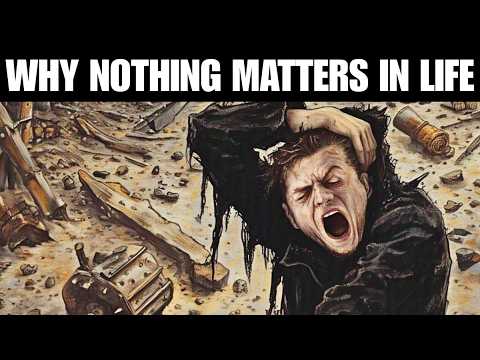
“The Abyss Within: Why Nothing Matters, and How That Changes Everything — Nihilism Through the Eyes of Camus, Nietzsche, & Islam”
A bold confrontation with meaninglessness, cosmic silence, and how Islamic theology dismantles nihilism with purpose, divine decree, and the soul’s accountability
1a. ⚰️ The Illusion of Meaning: Why What Once Mattered Now Feels Empty
📌 00:00
📝 The Point:
• We cling to relationships, careers, and dreams, but over time, their emotional weight fades.
• The heart wakes up disillusioned—what we thought was everything, feels like nothing.
• Nihilism enters when our pursuit of meaning collapses under the weight of time and repetition.
⚖️ The Law:
• Tawheed: Meaning is grounded in worship, not worldly attachments (Qur’an 51:56).
• Qadr (Divine Decree): Value is not self-invented, but divinely assigned.
• Tazkiyah: The ego seeks illusions; the purified soul sees through them.
🔮 And So:
• Emotional detachment from dunya isn’t depression—it may be spiritual awakening.
• Chasing worldly validation ends in decay; divine alignment leads to fulfillment.
• Islam accepts life’s impermanence but offers a transcendent anchor.
What if emptiness is the soul’s cry for divine purpose, not despair?
1b. 🌌 Camus and the Cosmic Joke: Embracing Absurdity Without God
📌 01:33
📝 The Point:
• Camus describes life as absurd: humans crave meaning from a mute, indifferent universe.
• The Myth of Sisyphus shows endless struggle with no victory—yet Camus dares to imagine him happy.
• His solution: rebel joyfully, live despite meaninglessness.
⚖️ The Law:
• Tawakkul (Trust in Allah): Islam offers cosmic justice—not absurdity.
• Sabr: Struggle isn’t pointless—it’s rewarded eternally.
• Shukr: Joy is not rebellion but gratitude for divine tests.
🔮 And So:
• Where Camus sees defiance, Islam sees divine submission.
• Rebellion against absurdity feels brave—but ultimately hollow.
• Without Allah, joy has no anchor—just momentary distraction.
Is it brave to laugh at the void—or foolish to ignore the Creator who fills it?
1c. ☠️ “God Is Dead”: Nietzsche’s Challenge and Islam’s Rebuttal
📌 02:34
📝 The Point:
• Nietzsche declared the death of God—not as news, but as cultural diagnosis.
• Without divine law, humans must invent values—become the Übermensch.
• Most people retreat to comfort ideologies, but the strong rise as creators.
⚖️ The Law:
• Rububiyyah (Lordship): Only Allah defines right and wrong.
• Hudud (Divine Limits): Man is not free to create morality.
• Fitrah: Truth isn’t invented—it’s remembered.
🔮 And So:
• The Übermensch is spiritually arrogant—Islam calls for humble servitude.
• Creating values breeds chaos; submitting to divine values brings harmony.
• “God is Dead” unchains the ego; Tawheed puts it back in its rightful place.
When man becomes god, who corrects his cruelty?
1d. ⛓️ Schopenhauer’s Cycle of Suffering: Is Desire the Real Disease?
📌 04:08
📝 The Point:
• Schopenhauer saw humans as slaves to desire—what we want torments us.
• Fulfillment brings momentary pleasure, then another craving.
• His cure: total detachment, Buddhist-style renunciation.
⚖️ The Law:
• Zuhd (Asceticism): Islam encourages detachment from dunya—not despair.
• Nafs: The ego is never satisfied.
• Ihsan: Mastery over desire, not escape from life.
🔮 And So:
• Schopenhauer’s cure removes suffering—but also removes life’s meaning.
• Islam redirects desire toward Jannah—not annihilation.
• Renunciation isn’t refusal—it’s refinement.
If we kill desire, do we lose the very engine of spiritual striving?
1e. ⚖️ Sartre’s Condemned Freedom vs. Islam’s Liberating Boundaries
📌 05:11
📝 The Point:
• Sartre said we’re “condemned to be free”—no divine plan, only raw choice.
• Most people retreat into “bad faith,” faking meaning through roles and labels.
• True existentialism demands we invent ourselves moment by moment.
⚖️ The Law:
• Taklif: Freedom in Islam includes responsibility.
• Shari’ah: Boundaries do not enslave—they protect.
• Tawheed: True freedom is submission to the Truth, not ego.
🔮 And So:
• Islam frees us from the burden of inventing identity.
• Boundaries don’t choke—they channel potential.
• Sartre’s freedom is anxiety; Islam’s submission is serenity.
What if the heaviest freedom is having no one to answer to—even yourself?
1f. 💔 Kierkegaard’s Agony: A Leap of Faith into the Unknown
📌 06:13
📝 The Point:
• Kierkegaard saw life as despair unless you make a leap of faith.
• Not reason, not evidence—just belief against all odds.
• It’s irrational—but possibly the only escape from nihilism.
⚖️ The Law:
• Iman bil Ghayb (Faith in the Unseen): Islam values reason, but centers faith.
• Yaqeen: Belief is strengthened by signs—not absent of them.
• Huda (Guidance): Faith is gifted when sought sincerely.
🔮 And So:
• Islam supports the leap—but with divine revelation, not pure blind hope.
• Kierkegaard reaches for God; Islam says God reached first.
• You don’t jump alone—Allah provides the rope.
Can you leap when faith isn’t foolish, but firmly rooted in revelation?
1g. ⚖️ Dostoevsky’s Dilemma: If God Doesn’t Exist, Is Everything Permitted?
📌 07:18
📝 The Point:
• Characters like Ivan Karamazov wrestle with moral collapse after God.
• Freedom without judgment becomes moral anarchy.
• Yet their guilt and torment reveal we cannot escape conscience.
⚖️ The Law:
• Taqwa: God-consciousness anchors morality.
• Akhlaq: Ethics come from revelation, not just instinct.
• Qiyamah: Judgment Day makes actions meaningful.
🔮 And So:
• Without divine accountability, cruelty becomes legal.
• Conscience alone is unreliable—it fluctuates.
• Only Allah can define, judge, and redeem us.
If justice is real, doesn’t it require a Just Judge beyond man?
1h. ☠️ Cioran’s Final Curse: Life Is a Mistake We Never Chose
📌 07:48
📝 The Point:
• Cioran calls existence a catastrophe. Birth itself is tragedy.
• Hope is poison; happiness, a fragile illusion.
• His worldview is pure despair—not defiance or remedy.
⚖️ The Law:
• Rahmah: Life is mercy—even in pain.
• Istirja’ (Returning to Allah): “Indeed we belong to Allah…” (2:156)
• Shifaa’: Healing exists for the soul—through dhikr and du’a.
🔮 And So:
• Despair is a whisper of Shaytan—not truth.
• If birth is pain, then faith is the midwife of meaning.
• Islam gives reason to endure—and to hope.
If life is a mistake, then why does your soul cry for purpose?
1i. 🧠 Hume’s Hollow Self: Are You More Than Just Thoughts and Flickers?
📌 08:48
📝 The Point:
• Hume argued the “self” is an illusion—just a series of passing sensations.
• No permanent soul. No true identity.
• This view fractures personhood and erodes responsibility.
⚖️ The Law:
• Ruh: The soul is real—breathed by Allah Himself (Qur’an 15:29).
• Accountability: We are judged as unified beings, not fragments.
• Qalb: The heart carries both memory and morality.
🔮 And So:
• If we are only flickers, there is no Day of Judgment.
• But Islam affirms continuity between soul, action, and destiny.
• Memory fades—but the soul remembers.
If you’re just thoughts, then who is it that feels remorse?
1j. ⚰️ Heidegger’s Death Clock: Life Only Matters Because It Ends
📌 09:51
📝 The Point:
• Heidegger says we live “toward death”—awareness of mortality makes us real.
• Most people avoid this by drowning in distractions.
• Authenticity begins by confronting the grave.
⚖️ The Law:
• Mawt (Death): “Every soul shall taste death…” (3:185)
• Hisab: Life’s moments are weighed.
• Tawbah: Death wakes up the heedless—while there’s still time.
🔮 And So:
• The grave isn’t an abyss—it’s a threshold.
• Mortality isn’t darkness—it’s divine invitation.
• You don’t just die—you return.
If death is certain, what are you preparing for its certainty?
Glossary
• Tawheed: Oneness of Allah.
• Qadr: Divine will and destiny.
• Fitrah: Innate human nature to recognize truth.
• Taqwa: God-consciousness.
• Ruh: The soul, divinely placed in humans.
• Akhirah: The Hereafter, where true justice is realized.
• Tawbah: Repentance.
• Zuhd: Worldly detachment rooted in divine trust.
• Hisab: Accountability on the Day of Judgment.
“The 10 Commandments of the Void: How to Face Nothingness Without Losing Your Soul”
Ten unflinching truths for surviving nihilism, reclaiming meaning, and resisting the despair of a godless universe with clarity, courage, and divine grounding
1. Thou shalt not mistake comfort for meaning.
Your relationships, dreams, and routines may soothe—but they cannot save. Only the Eternal can hold the weight of eternity.
2. Thou shalt embrace the absurd—but not bow to it.
Camus invites rebellion, but Islam calls for surrender—to the One who made the silence speak.
3. Thou shalt not worship self-made values.
Nietzsche’s Übermensch crafts his own code. You were gifted one—perfect, preserved, and divine. Use it or lose yourself.
4. Thou shalt not chase every desire.
Schopenhauer’s cycle of craving is real. But Islam teaches mastery, not renunciation—be its rider, not its prisoner.
5. Thou shalt not carry freedom without guidance.
Sartre gave you wings but no sky. Islam gives you the wings and the flight path. Choose wisely.
6. Thou shalt leap—but not into darkness.
Kierkegaard jumped blindly. You leap with Qur’an and Sunnah as your rope. Faith is not irrational—it is suprarational.
7. Thou shalt anchor morality in the Divine—not the crowd.
Dostoevsky feared the death of God would unleash chaos. He was right. Islam prevents it.
8. Thou shalt not call despair a virtue.
*Cioran called hope poison. But the Qur’an calls despair a sin: “None despairs of Allah’s mercy except the disbelieving people” (12:87).
9. Thou shalt know thyself as soul—not flicker.
Hume found no self in the mirror. The Qur’an says: “And they ask you concerning the soul. Say: The soul is by the command of my Lord…” (17:85).
10. Thou shalt live with death in mind—but not fear it.
Heidegger reminded you of the grave. The Prophet (SAW) said: “Remember often the destroyer of pleasures—death.” Not to paralyze—but to purify.
These are the truths carved into the void. Keep them, and you won’t just survive meaninglessness—you’ll expose it as the illusion it is.