“When Titans Collide: China’s Rise, America’s Reckoning, and the Road to Global Reordering”
⏱️ Time Interval: 00:00 – 47:31
✍️ Pre-Introduction: Who’s Speaking & What They Represent
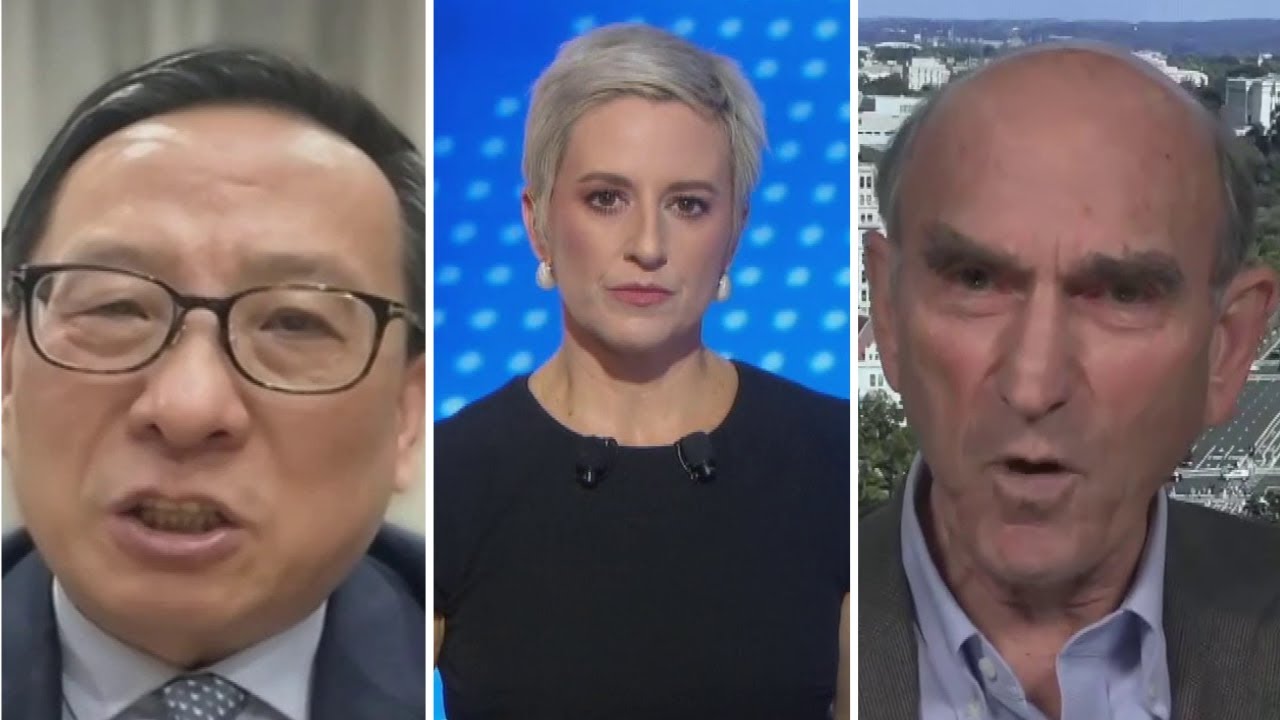
Elliot Abrams: A seasoned U.S. national security advisor who served under Reagan and Trump, representing mainstream American foreign policy interests, especially conservative realist views. Dr. Victor Gao: Vice President at the Center for China and Globalization in Beijing, former translator for Deng Xiaoping (leader of China post-Mao), and spokesperson for China’s global diplomatic and strategic outlook. Host: Melinda Nusphora: Journalist moderating the debate, representing Al Arabiya English.
📚 Summary with Deep Dive Analysis
1A. Inevitable Ascent, Imminent Collision
📝 The Point:
China’s meteoric rise in economic and military terms is framed as inevitable by Dr. Gao—an unstoppable trend that no country, including the U.S., can halt. The U.S., via Trump’s aggressive trade policies and rhetoric, finally reveals its deep-seated anxiety over losing global dominance. This is more than economics—this is about prestige, power, and influence. ⚖️ The Law: All nations have the sovereign right to economic development. Peaceful coexistence must remain foundational to global diplomacy. Superpowers should not weaponize trade or ideology. 🔮 And So: The U.S. appears cornered, reacting out of fear rather than foresight. China asserts itself not only as a competitor but a protector of a new order. We are no longer speculating; we are witnessing the beginning of a new bipolar world. “Is the fear of losing power justifying a new Cold War, or could mutual respect have prevented this descent?”
1B. Trade War to Total Decoupling
📝 The Point:
Trump’s tariffs and economic bullying are depicted as reckless and destructive—not just towards China but toward the rules-based global order. Gao frames China’s retaliation (up to 125% tariffs) not as aggression but defense of global trade integrity. Decoupling between the two economies is no longer theory—it’s in motion. ⚖️ The Law: Retaliatory policy must align with proportionality (proportionality = a principle requiring actions to match threats). Global trade stability depends on multilateral trust. Escalation without negotiation violates the spirit of diplomacy. 🔮 And So: Businesses worldwide face shockwaves as supply chains split. U.S.-China mutual trade suffers irreversible decline. The world braces for long-term division in tech, finance, and defense. “Can we afford to fracture the world’s two largest economies, or are we sleepwalking into a slow-burning global crisis?”
1C. The Proxy Game in the Philippines
📝 The Point:
The U.S. is accused of using the Philippines as a geopolitical pawn, despite violating its constitution by operating military bases. China warns of provocation disguised as partnership. Dr. Gao details colonial-era treaties to argue territorial legitimacy. ⚖️ The Law: Sovereignty must not be overridden by strategic interest. Military presence abroad requires host-nation constitutional compliance. Proxies often lead to unintended escalation. 🔮 And So: U.S. credibility in Asia is called into question. Philippines becomes a symbolic battleground of influence. Historical grievances reawaken new strategic tensions. “Does helping a friend justify violating their law, or are we mistaking dominance for diplomacy?”
1D. The Cold Logic of Mutually Assured Destruction (MAD)
📝 The Point:
China asserts its nuclear parity with the U.S., framing MAD as the ultimate peacekeeper. Abrams accuses China of aggressive expansion that contradicts its peace narrative. Military buildup is about deterrence, not conquest—says Gao. ⚖️ The Law: Nuclear restraint requires transparency and dialogue. Deterrence only works when both sides believe the other will retaliate. Peace must be more than the absence of war—it must be the presence of trust. 🔮 And So: The arms race reignites—not in quantity, but in readiness. Peace becomes performative—a balance of threats, not ideals. The rhetoric masks real dangers of strategic miscalculations. “If peace depends on the threat of extinction, can it ever be real?”
1E. Tech as the New Battlefield
📝 The Point:
Technological supremacy—AI (Artificial Intelligence), IP (Intellectual Property), patents—is now the core of global power. China claims leadership in innovation; U.S. counters with IP theft accusations. Huawei becomes the symbolic flashpoint. ⚖️ The Law: Innovation must be protected, but not monopolized. IP laws must transcend borders for fair trade. Economic dominance must not stifle collaborative growth. 🔮 And So: Innovation ecosystems begin to decouple. Nations turn inward, sparking parallel tech universes. Trust in shared innovation collapses. “Is technology the new territory to conquer, or a bridge we’re burning?”
🔢 Insights Based on Numbers
$25 Trillion: Projected size of China’s GDP by 2030—staggering momentum that puts real pressure on the U.S. ($ = US Dollar, GDP = Gross Domestic Product, the total value of all goods/services produced). 125% Tariffs: China’s retaliatory import duties—a bold escalation in the trade war. 140+ Countries: China’s claim as the top trading partner—indicating a wide economic reach and deep soft power potential.
These figures are not just statistics—they’re structural shifts in the global balance of power.
❓ Example Exploratory Questions
What does the video say about how rhetoric, symbolism, and emotion are used to sway international perception of the US-China relationship? (Enter E1 to ask) What does the video say about how intellectual property rights disputes reflect deeper ideological and economic clashes? (Enter E2 to ask) What does the video say about how smaller countries like the Philippines are affected by the power games of global superpowers? (Enter E3 to ask)
Commands
[L] Expand summary [A] Write an educational article [D] Create conclusion diagram [T] Assess my knowledge of the video through a multiple-choice quiz [I] Indicate timestamps
Glossary
IP: Intellectual Property – legal rights protecting inventions and creations. MAD: Mutually Assured Destruction – a doctrine where both sides can destroy each other in a nuclear war. GDP: Gross Domestic Product – the total market value of all goods and services produced in a country. Proxy War: A conflict where two powers use third parties to fight instead of direct confrontation. Tariff: A tax on imported goods. Ultimatum: A final demand or statement of terms with the threat of serious consequences if not met.