🧠 The Mathematical Proof of God’s Existence
1A. The Limits of Science vs. The Nature of God
📝 The Point:
• Science explains the natural world, but by its very definition, it cannot determine the existence of anything beyond nature.
• Atheists often claim that science eliminates the need for God, but this assumes science has the capacity to address the supernatural, which it does not.
• God, as typically conceived, is an omnipresent, omniscient, and omnipotent being, existing beyond physical constraints—unlike anything science studies.
⚖️ The Law:
• Science is self-limited: It only studies the natural world and cannot comment on the supernatural.
• Knowledge is domain-specific: What works for one field does not automatically apply to another.
• Absence of evidence is not evidence of absence: Just because science cannot measure God does not mean He does not exist.
🔮 And So:
• Assuming science disproves God is a logical fallacy; it simply lacks the tools to measure Him.
• If God exists beyond nature, He would not be confined to scientific scrutiny.
• The inability to disprove God scientifically may actually align with the concept of a transcendent deity.
❓ What if the very structure of knowledge itself confirms a being beyond knowledge?
1B. The Paradox of Mathematics—A Reality We Cannot Touch
📝 The Point:
• Math is not a physical thing—it cannot be seen, touched, or measured in the physical sense, yet it governs reality.
• Every mathematical principle exists only in the mind, yet math describes the physical universe with eerie precision.
• If math is purely conceptual, why does it so perfectly align with reality?
⚖️ The Law:
• Concepts can govern reality: Something does not need to be physical to be real.
• Consistency suggests an origin: If math was a human invention, inconsistencies would exist—but they do not.
• An external mind must precede a system: Any logical framework with infinite depth points to an intelligence behind it.
🔮 And So:
• The laws of mathematics existed before human discovery—implying an intelligence that structured them.
• If our minds simply “discover” math rather than create it, then math must come from an external, pre-existing mind.
• A reality structured by non-physical logic suggests a governing intelligence.
❓ Is math a human tool, or are we merely uncovering the language of something greater?
1C. The Infinite Nature of Math—A Fingerprint of the Divine
📝 The Point:
• Numbers are infinite, and every number has unique properties—no human could have “invented” this.
• Pi, the number governing circles, has an infinite number of decimals—humanity does not control these digits, we only uncover them.
• If the universe is finite but math is infinite, then math must come from outside the universe.
⚖️ The Law:
• Infinity is not a product of the finite: Something infinite cannot arise from something limited.
• Discovery, not invention: Mathematical truths exist before we find them, meaning they do not originate from human thought.
• Codes imply intelligence: The very structure of math suggests deliberate order, not chaos.
🔮 And So:
• Math operates with laws that humans do not dictate, suggesting a greater intelligence is at work.
• A finite universe could not have given birth to infinite mathematical principles—so they must originate elsewhere.
• The infinite structure of mathematics aligns more with an eternal mind than a random, materialistic process.
❓ If math was created by humans, why does it refuse to obey human control?
1D. Math as the Blueprint of Reality
📝 The Point:
• Every book ever written—or that ever could be written—is already encoded in math.
• If numbers correspond to letters, math contains all possible words, thoughts, and ideas before they are ever expressed.
• If numbers correspond to atomic positions, even our universe itself is mathematically prewritten.
⚖️ The Law:
• Math transcends time: It holds information that existed before its discovery.
• Mathematical order precedes human comprehension: We are discovering, not constructing, reality.
• A system of such depth requires intent: A structure so intricate and complete cannot be the product of chance.
🔮 And So:
• If all possible knowledge exists within math, then an intelligence has already arranged reality mathematically.
• The mathematical structure of everything suggests an underlying blueprint.
• The blueprint implies a planner, one who set the framework before existence itself.
❓ If every possible outcome already exists within math, is the universe itself a thought in the mind of God?
1E. The Fractal Nature of Reality—God’s Handwriting
📝 The Point:
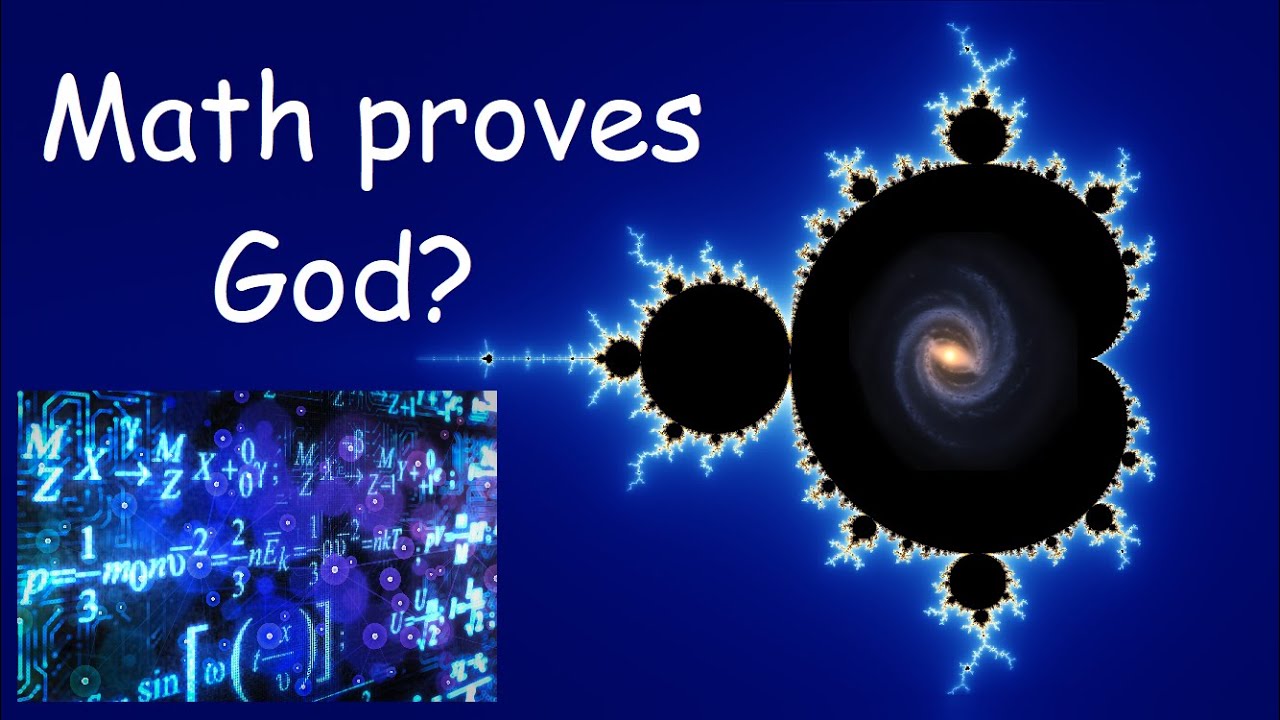
• The Mandelbrot Set, a mathematical equation, creates an infinite, self-repeating pattern when plotted.
• No matter how deep we zoom in, new patterns emerge—patterns no human has ever seen before.
• The complexity of these patterns, which we did not invent, suggests a structured design beyond human comprehension.
⚖️ The Law:
• Patterns imply a designer: Nature follows exact, repeatable principles.
• Infinite complexity cannot be random: If we find meaning in chaos, then the chaos is not truly chaotic.
• Discovery does not equal creation: Just because we found these patterns does not mean we caused them.
🔮 And So:
• The infinite depth of the Mandelbrot Set is eerily similar to the infinite mind described in theology.
• If mathematical structures existed before human discovery, their origin must be beyond human minds.
• The sheer intricacy of such structures hints at a conscious mind that crafted them.
❓ If an equation can produce infinite beauty, what does that say about the mind that designed the equation?
1F. Conclusion—Mathematics as the Mind of God
📝 The Point:
• If math is infinite, governs the universe, and exists beyond time and space, then it shares the qualities of a divine mind.
• Galileo once said, “Math is the language with which God has written the universe.”
• Truth, goodness, and beauty—like mathematical truth—exist independently of human opinions, pointing to an ultimate source.
⚖️ The Law:
• Truth must have an ultimate foundation: Without a higher mind, all knowledge is subjective.
• The foundation of reality must be unchanging: Math does not evolve; it simply is.
• A supreme intelligence must precede intelligence: A mind must exist beyond human thought to contain all knowledge.
🔮 And So:
• The mathematical structure of the universe strongly aligns with the classical concept of God.
• If God is the ultimate mind, then math is His language, prewritten into existence.
• Mathematics may be the clearest evidence of a structured, divine intelligence governing all reality.
❓ If the language of the universe is math, and math was not created by humans—who, or what, is speaking?