
🔥 “Jerusalem Burns: How a Fractured People, a Ruthless Empire, and a City of God Collided in 70 AD”
Why the fall of Jerusalem wasn’t just a military siege—but a human implosion, a spiritual reckoning, and a lesson history still bleeds from.
1A. The Spark That Lit the Fire
📌 00:00:33
📝 The Point:
• Judea’s instability, fueled by Roman mismanagement and deep internal divisions, primed it for revolt.
• The Great Revolt erupted after a massacre and looting in Jerusalem.
• Rome responded with overwhelming force led by Vespasian and his son, Titus.
⚖️ The Law:
• Oppression breeds resistance when legitimacy collapses.
• Empires neglecting nuance invite violent backlash.
• Internal division weakens the foundation before external attack.
🔮 And So:
• The revolt wasn’t sudden—it was an eruption decades in the making.
• The Jewish resistance was brave, but broken from within.
• The fall began not at the gates, but in the hearts of a splintered people.
If an empire mistreats a fractured land, what hope do the people have when their own unity is shattered?
1B. The City of Stone and Fire
📌 00:05:16
📝 The Point:
• Jerusalem was a fortress layered in ancient, towering walls built on rugged terrain.
• It was both physically and spiritually defended—every brick sacred.
• But it was also overcrowded, starved, and torn by civil war.
⚖️ The Law:
• Fortresses defend bodies, but only unity defends souls.
• Terrain gives advantage, but it cannot shield chaos within.
• A sacred place becomes a tomb when survival overrides sanctity.
🔮 And So:
• Jerusalem’s strength became its prison.
• Internal bloodshed weakened external resistance.
• The defenders died not just by Roman hands—but by their own collapse.
Can a city built to honor God survive when His people turn on each other?
1C. The Roman Juggernaut Arrives
📌 00:09:09
📝 The Point:
• Titus led four legions, joined by thousands of auxiliaries and client troops.
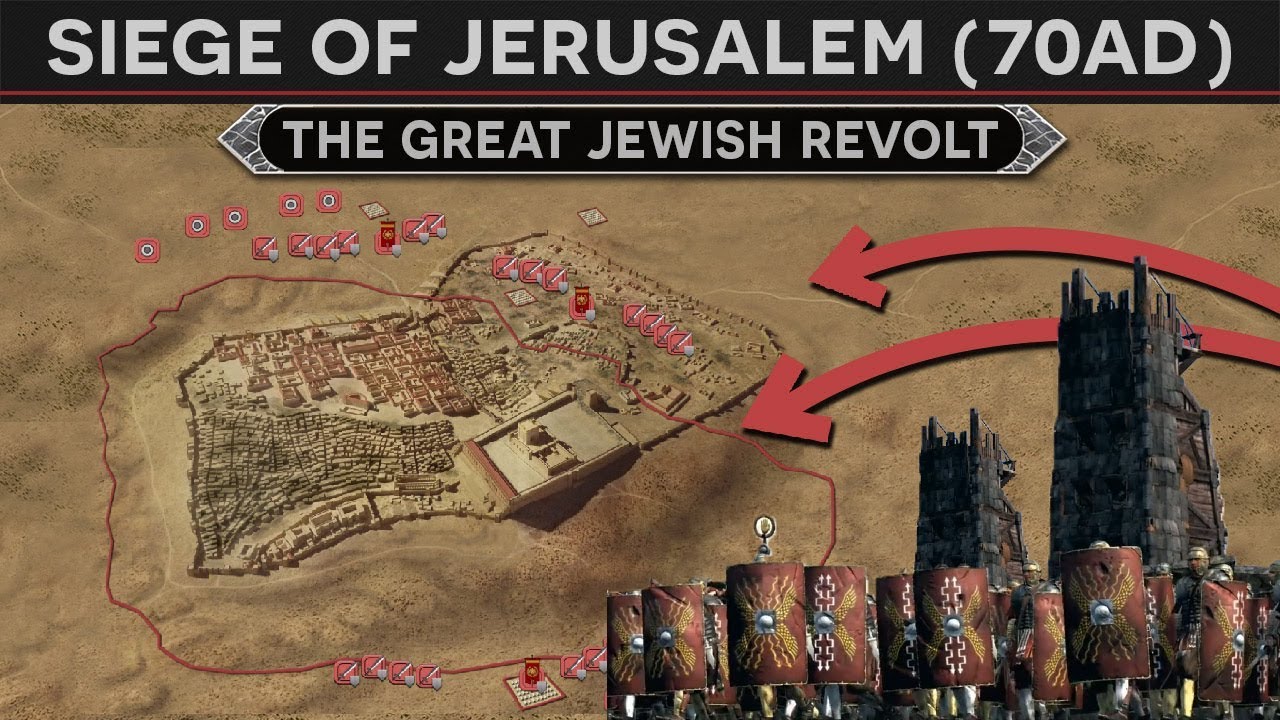
• They surrounded the city with siege camps and began methodical conquest.
• Early Jewish victories gave them hope—but Rome quickly adapted.
⚖️ The Law:
• Great empires crush through patience and infrastructure, not speed.
• Overconfidence in early wins clouds long-term judgment.
• Momentum can shift fast in asymmetrical warfare.
🔮 And So:
• Jewish courage could not match Roman machinery.
• Titus’ strategic reshuffling neutralized their early gains.
• The siege was no longer about “if,” but “when.”
What’s more dangerous than an enemy with numbers? An enemy that learns.
1D. Wall After Wall, Hope Crumbles
📌 00:17:09
📝 The Point:
• Rome breached Jerusalem’s three defensive walls through relentless ramps, towers, and brute siege engineering.
• Each breach pushed defenders further back, until they were cornered in the Temple Mount.
• Every retreat was tactical—but also a psychological defeat.
⚖️ The Law:
• Defense cannot win without counteroffense.
• Tactical retreats preserve life, but bleed morale.
• A fortress without mobility becomes a coffin.
🔮 And So:
• Layered defense only prolonged agony.
• The shrinking perimeter mirrored shrinking faith.
• The city became a maze of death traps.
Can falling back ever be brave if there’s nowhere left to stand?
1E. When Hunger Is a Weapon
📌 00:23:55
📝 The Point:
• Titus ordered a circumvallation wall, sealing Jerusalem completely.
• Hunger became the silent killer—people ate pets, hay, even infants.
• Romans crucified escapees, gutting defectors searching for hidden gems.
⚖️ The Law:
• Siege warfare punishes the innocent to reach the few.
• Starvation breaks resistance faster than swords.
• Desperation reduces humans to survival shadows.
🔮 And So:
• The city starved as its spirit broke.
• Starvation erased the boundary between civilian and combatant.
• Hunger became the most powerful Roman general.
What happens to morality when your enemy controls your next meal?
1F. The Temple of God Becomes a Pyre
📌 00:36:26
📝 The Point:
• A flaming timber thrown into the Temple ignited sacred chambers.
• The Temple, center of Jewish worship, was consumed.
• Chaos followed—slaughter, looting, desecration.
⚖️ The Law:
• Sacred spaces offer no sanctuary in total war.
• Holy fire turns to hellfire when control is lost.
• Rage erases restraint in the final throes.
🔮 And So:
• The spiritual center was reduced to ashes and screams.
• The last bond between people and divine was severed.
• What was once holy became horrifying.
If your god’s house burns, what part of you survives the smoke?
1G. The Final Stand & Collapse
📌 00:41:12
📝 The Point:
• Remaining Jewish forces fled to Herod’s palace and tunnels.
• Resistance was minimal—morale shattered, bodies weakened.
• One final breach, and the city was lost.
⚖️ The Law:
• Final stands are often symbolic, not strategic.
• Collapse doesn’t come at once—it crumbles quietly, then all at once.
• Some battles are lost long before the first sword swings.
🔮 And So:
• Rome claimed its victory not just by force—but by wearing souls thin.
• The last screams were echoes of thousands already silenced.
• Resistance faded—not from lack of courage, but lack of breath.
When the body holds a sword but the spirit drops it—has the war already ended?
1H. A Triumph Built on Bones
📌 00:42:42
📝 The Point:
• Titus paraded through Rome with slaves, relics, and the menorah.
• Jewish leaders were strangled in symbolic submission.
• The Flavian dynasty used blood and fire to legitimize rule.
⚖️ The Law:
• History is written by victors—but paid for by victims.
• Symbols of destruction become tools of power.
• Triumph often requires trauma.
🔮 And So:
• The Temple’s ashes became an emperor’s crown.
• The oppressed became spectacle.
• Legitimacy rose from ruin.
Is power still noble when its throne is made of someone else’s home?
Glossary
• Siege of Jerusalem (70 AD): Roman military campaign that destroyed the city and Second Temple.
• Titus: Roman general (later emperor) who led the siege.
• Temple Mount: Sacred Jewish site, final stronghold during the siege.
• Circumvallation: Siege tactic—building a wall around a city to starve and trap defenders.
• Zealots: Jewish militant group who resisted Roman occupation.
• Herod’s Palace: Final Jewish resistance point in Jerusalem.
• Menorah: Sacred candelabrum taken as trophy to Rome.
• Josephus: Jewish historian who chronicled the war and siege.


