
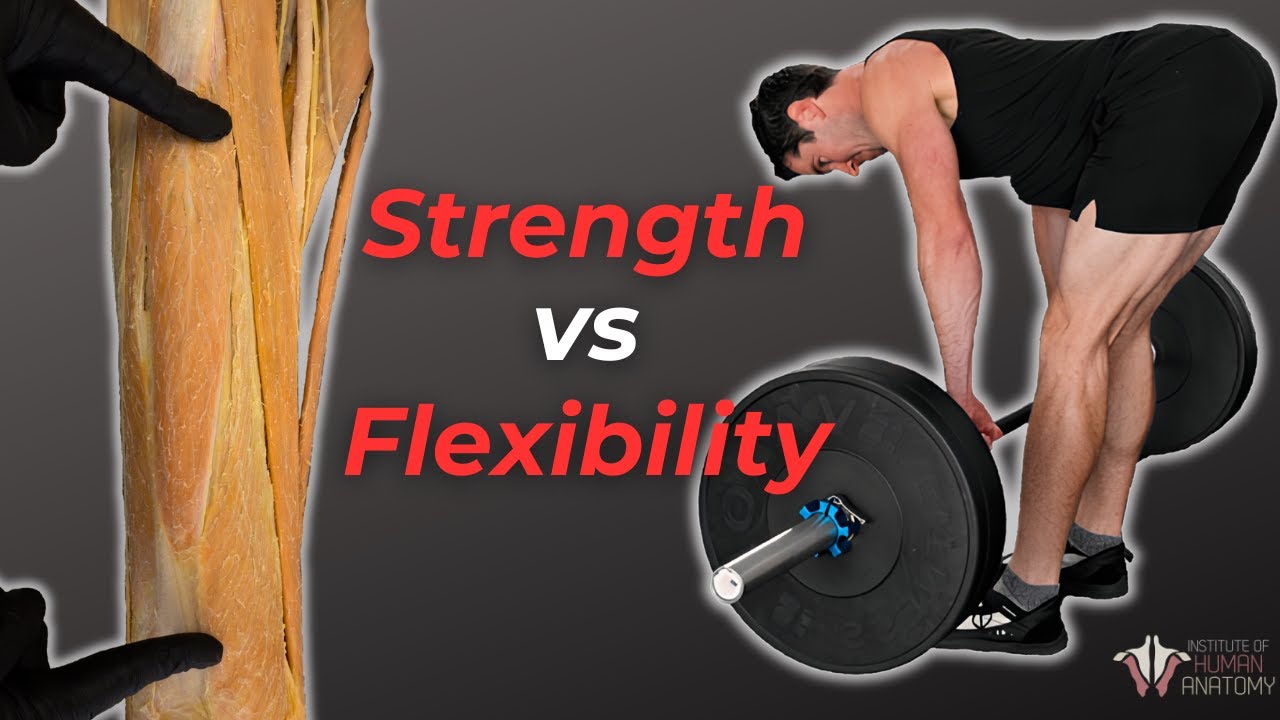
💪 Strength Through Length: The Best Way to Build Strength AND Flexibility
1. 🏋️ Strength and Flexibility: A False Trade-Off?
Point: Many believe that strength and flexibility are opposing qualities.
Principle: Traditional training methods separate strength exercises from flexibility training.
Inference: There may be a better way to train both attributes simultaneously.
2. 🔍 Static Stretching: Is It Enough?
Point: Static stretching is common but may not provide the best strength benefits.
Principle: Stretching alone doesn’t significantly reduce injury risk or improve strength.
Inference: A more dynamic approach might be necessary for functional improvements.
3. 🔄 Eccentric Training: A Game Changer
Point: Eccentric training (focusing on controlled muscle lengthening) improves both strength and flexibility.
Principle: Lowering a weight slowly increases time under tension, stimulating muscle adaptations.
Inference: Incorporating eccentric exercises into workouts enhances flexibility while building strength.
4. 📊 Muscle Contraction Phases Explained
Point: Muscles go through concentric, eccentric, and isometric contractions.
Principle: Strength training typically focuses on concentric contractions, but eccentric loading has unique benefits.
Inference: Understanding these phases allows for more effective training.
5. 🏋️♂️ Romanian Deadlifts for Strength & Mobility
Point: Romanian deadlifts (RDLs) stretch the hamstrings while strengthening them.
Principle: Performing slow, controlled eccentrics improves flexibility and strength simultaneously.
Inference: RDLs should be a staple for those looking to improve mobility and power.
6. ⏳ Time Under Tension: The Key to Adaptation
Point: Longer eccentric contractions increase time under tension, leading to muscle adaptations.
Principle: Controlled movements maximize muscle activation and flexibility improvements.
Inference: Slow, deep reps are more effective than simply increasing weight.
7. ⚖️ Full Range of Motion vs. Partial Reps
Point: Training with a full range of motion leads to better mobility and strength.
Principle: Partial reps may be useful for specific training but limit flexibility improvements.
Inference: Prioritizing deep, controlled movements builds a stronger, more mobile body.
8. 🏗️ Strength Through Length: The Ultimate Injury Prevention
Point: Strengthening muscles in a lengthened position reduces injury risk.
Principle: Most injuries occur during eccentric loading, so training this phase helps prevent them.
Inference: Building strength in stretched positions “bulletproofs” the body.
9. 🦵 ATG Split Squats: The Ultimate Mobility & Strength Exercise
Point: ATG (Ass-to-Grass) split squats target the quads, hip flexors, and calves simultaneously.
Principle: They combine strength and flexibility, improving lower-body mechanics.
Inference: This exercise should be a core movement in every strength and mobility program.
10. 📉 Static Stretching vs. Eccentric Training: The Science
Point: Studies show both methods improve flexibility, but eccentric training also increases strength.
Principle: If forced to choose, eccentric training provides more overall benefits.
Inference: A combination of both methods optimizes results.
11. 🏆 Maximizing Strength & Flexibility: The Best Approach
Point: Combining eccentric training, full range of motion exercises, and static stretching yields optimal results.
Principle: Strength and mobility should be trained together, not separately.
Inference: Anyone can improve their flexibility and strength with a well-balanced training program.
💡 Final Thoughts & Knowledge Gaps
- 📌 Strength and flexibility can be developed simultaneously using eccentric training.
- 📌 Training through a full range of motion is superior for mobility and strength.
- 📌 ATG split squats and Romanian deadlifts are excellent exercises for lower-body strength and flexibility.
- 📌 A combination of eccentric training and static stretching maximizes results.