
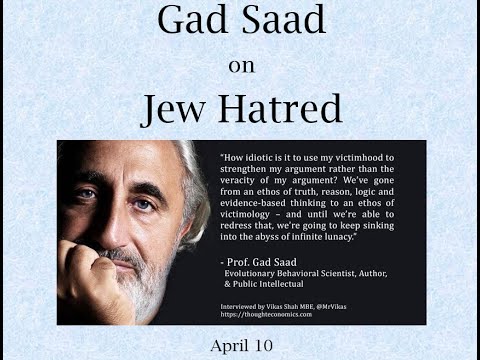
The Eternal Struggle: Gad Saad on Antisemitism and the Battle for Truth
[🔥 Unveiling the Deep-Rooted Bias Against Jews 🔥]
🔗 Watch the full video here: YouTube Link
🔎 Understanding the Narrative
Dr. Gad Saad explores Jewish history, antisemitism, and the cultural and political factors fueling contemporary Jew hatred. He provides a personal perspective, sharing his family’s experiences in Lebanon and linking them to global trends of antisemitism today.
🔍 Key Themes in the Video
- The historical persecution of Jews in the Middle East and beyond
- Modern Jew hatred in academia, politics, and media
- The rise of antisemitism after October 7, 2023
- Diversity, Equity, and Inclusion (DEI) initiatives and their failure to protect Jewish communities
- Western naivety in understanding cultural hostility toward Jews
- The dangers of progressive politics when it ignores antisemitism
- The concept of “suicidal empathy”—when compassion leads to self-destruction
⚡ The Core Arguments: Thought Processes & Biases
1️⃣ Claim: “Jew Hatred is an Eternal Phenomenon”
📍 Timestamp: 255s
Thought Process Breakdown
- Statement: “Jew hatred has existed across time, cultures, and political systems.”
- Leading Thought: Jews were persecuted in Lebanon, Europe, and now in the West.
- Thought 2: Even in so-called progressive societies, antisemitism exists.
- Thought 3: Every major historical crisis has blamed Jews in some way.
- Conclusion: Jew hatred is deeply embedded in many cultures.
- Implication: If taken to the extreme, this could suggest that antisemitism is inevitable and unsolvable.
🛑 Prejudicial Device Used: Historical Determinism—The assumption that because something has happened historically, it will continue indefinitely.
✅ Counter-Rebuttal:
- History shows progress is possible. While Jew hatred has existed, many societies have moved toward tolerance and coexistence.
- Education reduces prejudice. Studies show that exposure to Jewish culture, history, and individuals decreases antisemitic views.
- Laws and societal norms shape behavior. Countries with strong legal protections against hate speech and discrimination have lower levels of antisemitism.
2️⃣ Claim: “Antisemitism in the Middle East is Institutionalized”
📍 Timestamp: 318s
Thought Process Breakdown
- Statement: “In Lebanon, Jews were marked as ‘Israelites’ on their ID cards.”
- Leading Thought: Jewish identity was a legal disadvantage.
- Thought 2: There were random roadblocks where being Jewish could be a death sentence.
- Thought 3: The Lebanese Civil War worsened antisemitic violence.
- Conclusion: Jewish persecution in the Middle East was systemic.
- Implication: If taken to the extreme, this viewpoint supports the idea that Jews can never live safely in Arab nations.
🛑 Prejudicial Device Used: Overgeneralization—While antisemitism exists in some Arab nations, it does not define all Middle Eastern cultures or people.
✅ Counter-Rebuttal:
- Historical periods of coexistence existed. Jewish communities thrived in the Ottoman Empire, Moorish Spain, and parts of the Arab world.
- Antisemitism varies by country. Morocco and the UAE have taken steps to improve Jewish relations.
- Education and diplomacy can change perceptions. Initiatives like the Abraham Accords have fostered Jewish-Muslim cooperation.
3️⃣ Claim: “DEI (Diversity, Equity, Inclusion) Ignores Jewish Suffering”
📍 Timestamp: 92s
Thought Process Breakdown
- Statement: “DEI policies focus on race and gender but ignore antisemitism.”
- Leading Thought: Universities like Cornell prioritize fighting Islamophobia but not antisemitism.
- Thought 2: Jewish students face increasing hostility on campus.
- Thought 3: Administrators refuse to acknowledge or act against Jewish discrimination.
- Conclusion: DEI is selective in addressing bigotry.
- Implication: If taken to the extreme, this could suggest that DEI is inherently antisemitic.
🛑 Prejudicial Device Used: False Dichotomy—Assuming that protecting one group (e.g., Muslims) means neglecting another (Jews).
✅ Counter-Rebuttal:
- DEI can evolve. Institutions can expand their definitions of discrimination to include antisemitism.
- Intersectionality applies to Jewish identity. Jews can be both privileged and persecuted in different contexts.
- Education and advocacy can influence DEI policies. Jewish organizations can push for equal protection under DEI initiatives.
4️⃣ Claim: “The West is Naive About Jew Hatred”
📍 Timestamp: 1254s
Thought Process Breakdown
- Statement: “Western liberals refuse to acknowledge antisemitism from Islamic extremists.”
- Leading Thought: Many progressives believe Jew hatred is only a right-wing issue.
- Thought 2: Leftist movements focus on oppressed/oppressor dynamics, casting Jews as oppressors.
- Thought 3: Some Jews themselves are complicit in defending ideologies that promote antisemitism.
- Conclusion: Western liberals unintentionally enable Jew hatred.
- Implication: If taken to the extreme, this could justify hostility toward leftist movements.
🛑 Prejudicial Device Used: Framing Bias—Presenting all progressive views as naive or dangerous.
✅ Counter-Rebuttal:
- Not all progressives ignore antisemitism. Many leftist thinkers and politicians actively fight Jew hatred.
- Jewish involvement in progressive causes has deep roots. From civil rights to LGBTQ+ activism, Jews have been central to many progressive movements.
- Focusing on shared struggles can bridge gaps. Addressing antisemitism within leftist spaces through dialogue, rather than division, is more effective.
5️⃣ Claim: “Western Empathy Can Be Suicidal”
📍 Timestamp: 5269s
Thought Process Breakdown
- Statement: “Excessive Western empathy leads to cultural self-destruction.”
- Leading Thought: Western societies prioritize inclusivity at the expense of security.
- Thought 2: This includes policies that allow dangerous ideologies to spread unchecked.
- Thought 3: The idea of “suicidal empathy” explains why Western societies tolerate groups that seek their downfall.
- Conclusion: Western kindness can be weaponized.
- Implication: If taken to the extreme, this could justify xenophobic or isolationist policies.
🛑 Prejudicial Device Used: Slippery Slope—Assuming that empathy inevitably leads to societal collapse.
✅ Counter-Rebuttal:
- Empathy and security can coexist. Effective policies can ensure both inclusivity and safety.
- Not all immigrants or marginalized groups are threats. Generalizing entire populations based on a few extremists is flawed reasoning.
- The West’s strength lies in its values. Freedom, tolerance, and diversity have been core to Western success.
🔥 Conclusion: Fighting Antisemitism Through Awareness & Action
Dr. Gad Saad’s arguments highlight real concerns about antisemitism but sometimes lean into overgeneralization and pessimism.
Key Takeaways
✅ Antisemitism exists across political and cultural spectrums.
✅ Education and advocacy are key to combating Jew hatred.
✅ Progressives and conservatives alike must address antisemitism.
✅ Jewish identity should not be weaponized for political agendas.
🔹 The fight against antisemitism is a collective responsibility.
🔹 Dialogue, education, and policy change are more effective than division.
🔹 Jews have historically thrived in diverse societies and can continue to do so.
💡 Final Thought: Rather than succumbing to despair, we must take action, educate, and build a future free of hate. 🚀